
Technology profile · Accelerated computing · AI
Jensen Huang: From Graphics Chips to the AI Computing Era
By LinkinGrow · · AI-assisted editorial analysis
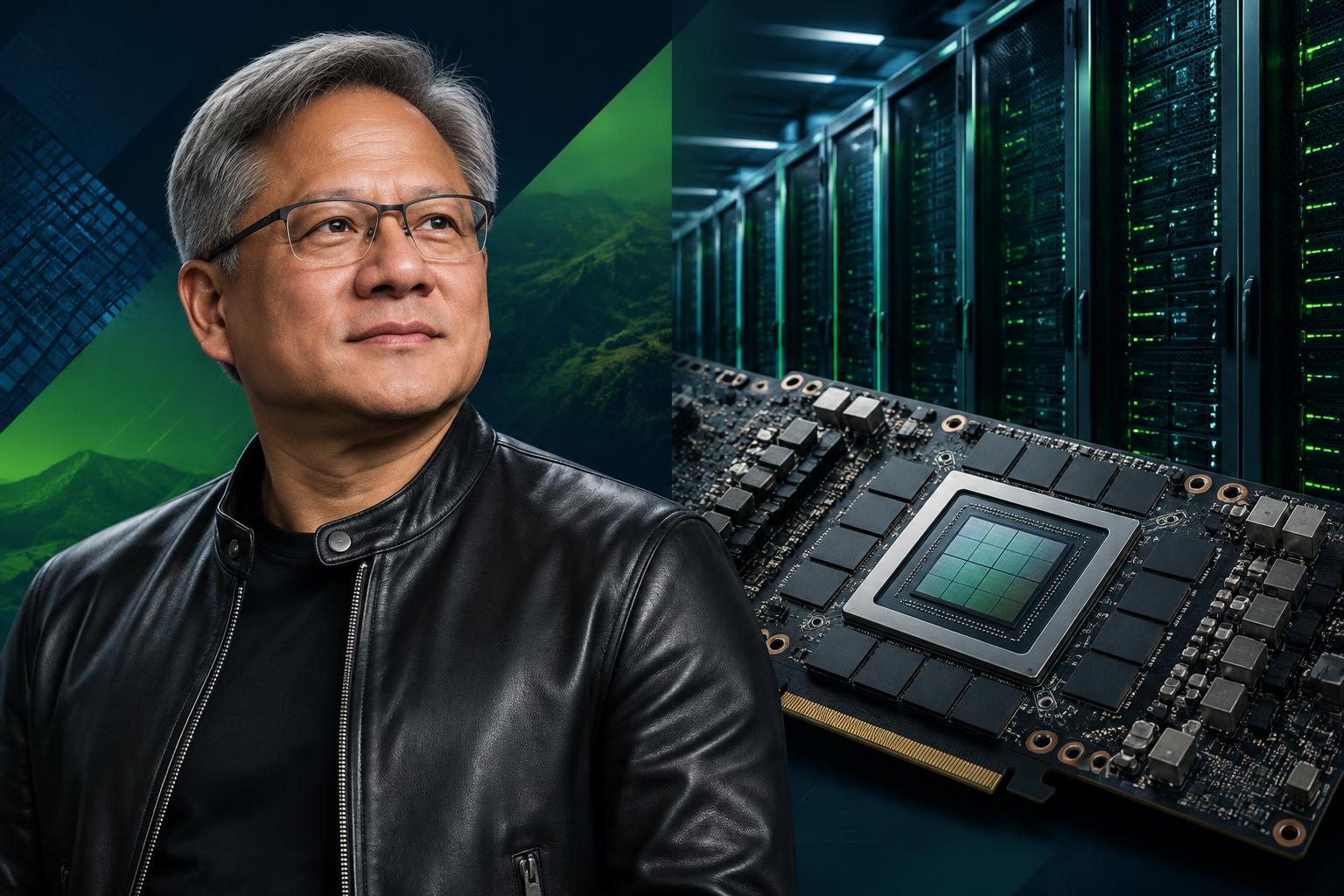
The story is bigger than a chip: how programmable GPUs, a developer ecosystem, and system-level engineering helped shape modern AI—and what the infrastructure narrative leaves out.
The short answer
Jensen Huang is NVIDIA’s co-founder and chief executive, and a central figure in the shift from graphics hardware to accelerated computing and AI infrastructure. His importance is not that he invented artificial intelligence or built a chatbot. It is that NVIDIA helped turn the graphics processing unit into a programmable computing platform, then built software and systems around it.
The useful way to understand Huang is through three connected decisions: make parallel processors programmable, invest in the developer ecosystem, and optimize the whole computing system rather than only the chip. This article examines that trajectory, explains the technology, and separates NVIDIA’s commercial narrative from what buyers can actually evaluate.
Scope and disclosure: this is an AI-assisted, source-led technology profile, not an interview, a product test, or investment advice. Company documentation establishes NVIDIA’s stated designs and positioning; it is not independent proof of superiority. Historical research is credited to its authors. No benchmark results or private conversations are claimed.
Who is Jensen Huang?
Huang co-founded NVIDIA in 1993 and has served as its president, CEO, and a director since inception. NVIDIA’s biography records earlier roles at AMD and LSI Logic, a bachelor’s degree in electrical engineering from Oregon State University, and a master’s degree from Stanford. 1
NVIDIA’s corporate timeline names Chris Malachowsky and Curtis Priem as fellow founders. Its initial focus was 3D graphics for gaming and multimedia—not a ready-made generative AI market. 2
That distinction matters. Retrospective accounts can make a company’s evolution sound inevitable. In reality, a graphics business, a scientific computing platform, and an AI infrastructure supplier solve different customer problems. Huang’s career is interesting because NVIDIA connected those markets through reusable technology, not because every later application was foreseeable.
From pixels to parallel computing
A CPU is designed to handle a wide variety of tasks, including branching decisions and operating-system work. A GPU is built to execute many operations in parallel. Graphics processing contains large amounts of repeated mathematical work; so do many simulations and neural-network computations.
That does not make a GPU a universally faster CPU. Workloads need enough parallelism, and the cost of moving data can erase an apparent advantage. A small task dominated by sequential logic may remain better suited to a CPU.
Accelerated computing means assigning suitable portions of an application to specialized processors while the CPU continues to coordinate other work. The question is not “Which chip is fastest?” but “Which parts of this workload can run efficiently on which hardware?” Huang’s 2016 explanation of GPU-accelerated AI explicitly places deep learning within this broader computing model. 3
For a non-specialist, imagine a kitchen: the CPU coordinates the order and handles exceptions; the GPU performs a large batch of similar preparation tasks. The analogy has limits, but it explains why cooperation matters more than replacing one processor with another.
CUDA: why software changed the hardware story
NVIDIA describes CUDA, launched in 2006, as a parallel computing platform and programming model. It allows developers to use GPU computing for applications beyond graphics and includes libraries, development tools, and supported programming-language interfaces. 4
The strategic importance is straightforward: a chip becomes more useful when researchers can express a problem, debug it, profile it, and reuse optimized software instead of starting from low-level hardware instructions.
Three layers are worth distinguishing:
- Hardware capability: the processor’s execution units, memory capacity, and bandwidth.
- Software usability: compilers, libraries, diagnostics, and framework integration.
- Operational reliability: deployment, compatibility, monitoring, and support over time.
Editorial analysis: CUDA’s significance is therefore not just a speed claim. It reduces some of the work required to turn an algorithm into a functioning GPU application. Existing code, team knowledge, and libraries can also make a platform expensive to leave. That is an engineering dependency to assess—not proof that competing platforms cannot perform well.
A buyer should ask which dependencies are actually CUDA-specific. Application interfaces, model formats, and some framework-level code may be portable; highly optimized kernels and operational tooling may require substantial changes.
AlexNet: credit the research, understand the infrastructure
The 2012 paper ImageNet Classification with Deep Convolutional Neural Networks was written by Alex Krizhevsky, Ilya Sutskever, and Geoffrey Hinton. It describes a large convolutional neural network and an efficient GPU implementation used to make training faster. It is a landmark example of how algorithms, data, and accessible compute can reinforce one another. 5
NVIDIA’s history associates its GPUs with this breakthrough. That is different from saying Huang authored AlexNet or invented deep learning. The researchers supplied the scientific contribution; GPU infrastructure helped make the experiment practical.
For readers following technology leadership, this is the more useful lesson: enabling tools can have enormous impact without being the sole origin of a discovery. Modern AI likewise depends on many contributors—researchers, open-source maintainers, chip designers, memory suppliers, networking specialists, and data-center operators.
Why LLMs made the system—not just the chip—matter
Large language models use substantial matrix computation, but arithmetic throughput alone does not determine usable performance. Model weights must fit in memory or be distributed. Data must move between processors. Requests must be scheduled. Software must make efficient use of available resources.
A deployment can be constrained by:
- Compute: how quickly the required operations execute.
- Memory capacity: whether weights and runtime state fit.
- Memory bandwidth: how quickly data reaches the execution units.
- Interconnect: how efficiently multiple processors exchange information.
- Serving software: batching, caching, scheduling, and utilization.
- Facilities: power delivery, cooling, and physical installation.
NVIDIA’s Blackwell documentation illustrates this integrated approach: it describes GPU architecture, Transformer Engine technology, NVLink connectivity, and the interaction with software such as TensorRT-LLM. Treat it as a documented example of platform design, not a claim that Blackwell is the newest or best choice for every deployment in 2026. 6
Lower-precision computation can reduce memory requirements and improve throughput, but the effect on quality needs evaluation for the specific model and task. Similarly, a fast interconnect can help distributed workloads, but not every small application needs a tightly integrated multi-GPU system.
Training and inference are different businesses
Training updates model parameters using data. Inference uses an existing model to generate outputs. A business can rely on advanced AI without ever training a frontier model.
| Question | Training | Inference |
|---|---|---|
| Main activity | Learn or update model parameters | Answer a request using a model |
| Operational emphasis | Completing experiments or training runs | Serving requests within quality and latency targets |
| Common constraints | Memory, compute, communication, experiment stability | Memory, concurrency, response time, serving efficiency |
| Useful outcome measure | Cost and time to reach an evaluated model | Cost per accepted result at a required service level |
These distinctions are simplified engineering guidance, not a benchmark table. Fine-tuning, evaluation, and retrieval add their own workloads.
Inference is especially important to business buyers because costs recur as applications are used. An impressive peak throughput figure is less useful than knowing the cost of a correct, timely answer under realistic demand.
For a customer-support assistant, “tokens per second” is only part of the story. Does it retrieve the correct policy, refrain from inventing a refund, and escalate appropriately? Hardware supports that workflow; it does not establish its accuracy.
What Huang means by an “AI factory”
NVIDIA uses “AI factory” to describe infrastructure that combines accelerated computing and AI software to produce outputs at scale. Its materials connect energy, chips, infrastructure, models, and applications, with an emphasis on token generation and inference. 7
The phrase is useful when it reminds buyers that AI is an operational system. It becomes less useful if it turns output volume into a proxy for intelligence or value.
Editorial analysis: a better business interpretation is a repeatable production workflow: inputs enter, models process them, outputs are checked, and failures feed back into improvement. “More tokens” is not a sufficient success criterion. Useful answers, safe actions, and measurable outcomes are.
A document-processing application, for example, should be judged by the percentage of records correctly extracted and validated—not the volume of generated text. That distinction prevents infrastructure procurement from becoming detached from customer needs.
Agents, robotics, and the limits of the infrastructure thesis
AI agents extend model outputs into tool use: searching, accessing permitted records, running code, or taking bounded actions. Robotics adds interaction with physical environments. Both can increase the importance of inference, simulation, and system integration.
But neither is solved by buying faster hardware. Agents still need permissions, reliable tools, evaluation, and recovery from errors. Physical systems additionally need sensing, control, and safety validation.
NVIDIA’s AI-factory materials position its infrastructure for agentic AI and physical AI. That documents the company’s direction; it does not prove that any particular agent or robot is production-ready.
The engineering lesson is to separate capacity from capability. Capacity is how much work a system can execute. Capability is whether it performs the required task reliably. More capacity can help experimentation and deployment, but cannot substitute for task-specific evidence.
The strongest parts of Huang’s strategy—and its trade-offs
This section is editorial analysis based on the platform described in the sources, not an assessment of NVIDIA’s share price or a prediction of market leadership.
1. Build around developers, not specifications alone
Tools and reusable libraries help customers turn theoretical performance into working applications. The trade-off is dependence on platform-specific software and expertise.
2. Optimize the full system
Compute, memory, networking, and serving software must work together. Integrated systems can reduce some coordination burdens, but buyers should examine upgrade flexibility, compatibility, and total cost.
3. Connect research infrastructure to production
A platform that supports experimentation and deployment can shorten the transition between them. Yet a research result does not automatically become a safe, economically viable product.
4. Explain a large technological shift clearly
“Accelerated computing” and “AI factory” give audiences a way to understand complex systems. The risk is that a persuasive category narrative can outrun evidence about individual applications.
Where a critical reader should push back
A balanced profile should not equate NVIDIA’s commercial interests with an inevitable computing future.
- GPU suitability is workload-specific. CPUs and other accelerators remain relevant. Evaluate the application rather than assuming every workload needs a GPU.
- Vendor comparisons need matched conditions. Model version, precision, batch size, latency target, and software configuration can change results.
- Power and cooling are real operating costs. Ask for measured consumption and installation requirements; this article makes no numerical claim about industry-wide energy use.
- Migration has costs. Quantify code changes, staff training, tooling, and downtime before declaring a platform portable or locked in.
- Demand is not the same as return on investment. Infrastructure spending only creates durable value if applications deliver accepted outcomes.
- A founder narrative is incomplete. NVIDIA’s development depends on employees, partners, researchers, and a wider semiconductor supply chain.
A product announcement is evidence that a vendor has announced something. It is not independent verification of delivery, availability, or performance in your environment.
A practical evaluation checklist for businesses
Before treating Huang’s computing thesis as a purchasing decision, answer these questions:
- What task are we improving? Define an observable outcome, not a general aspiration to “use AI.”
- What quality threshold is required? Record failure types, unacceptable errors, and escalation rules.
- What workload will run? Identify model size, context length, request volume, peak concurrency, and data handling requirements.
- Where should it run? Compare a managed API, rented GPU capacity, and owned hardware using the same workload.
- How will we measure cost? Include retries, retrieval, validation, human review, infrastructure, and maintenance.
- Which dependencies are specific to the vendor? Document kernels, libraries, serving software, and operational tooling.
- Can we reproduce the result? Save model versions, configurations, test inputs, and acceptance criteria.
- What happens when it fails? Provide a rollback, fallback, and human escalation path.
The correct outcome may be a modest hosted service rather than an owned GPU cluster. Small organizations should not imitate a frontier laboratory’s infrastructure merely because the technology is impressive.
A worked example: evaluate useful work, not hardware prestige
The following is a fictional scenario, not an NVIDIA customer story or a tested result.
A parts distributor wants to extract part numbers, quantities, and delivery dates from supplier documents. It is considering a managed model service and a self-hosted model on rented GPUs.
Its evaluation uses the same authorized document set for both options, separates clean scans from difficult ones, and asks a reviewer to assess field-level accuracy. It tracks completion time, failed extractions, review effort, and total operating cost. Sensitive documents require a separate data-governance review.
The distributor chooses only after assessing the cost per correctly processed document and the ability to recover from errors. This is the actionable version of accelerated computing: connect technical choices to verified work, rather than treating a processor brand as the outcome.
No numerical result is presented because no experiment was conducted.
What Jensen Huang’s story means for online discovery
For publishers and marketers, Huang’s infrastructure story explains part of the supply side of AI search: systems need compute to retrieve information, generate answers, and serve users. It does not reveal a secret ranking formula.
NVIDIA does not decide which brand ChatGPT or Google recommends merely by supplying underlying hardware. Visibility also depends on the search product, retrieval system, sources, query, and model behavior.
The useful response is to publish accurate, distinctive, accessible evidence and measure what answer engines actually do. Buying AI capacity or repeatedly mentioning NVIDIA does not establish credibility. Compute makes an answer possible; trustworthy information makes an answer worth using.
FAQs
Did Jensen Huang invent AI?
No. AI has a long research history. Huang co-founded NVIDIA, whose hardware and software have helped enable accelerated computing and modern AI workloads. The AlexNet paper, for example, was authored by Krizhevsky, Sutskever, and Hinton.
Does NVIDIA make ChatGPT or Claude?
No. NVIDIA supplies computing technologies and AI software. ChatGPT is an OpenAI product and Claude is an Anthropic product. An infrastructure supplier is distinct from the organization building and operating an assistant.
Is CUDA a chip?
No. CUDA is NVIDIA’s parallel computing platform and programming model. It helps software use supported GPU hardware.
Are GPUs always better than CPUs?
No. They are suited to different kinds of work. Parallel workloads can benefit from GPUs, while sequential work, coordination, and other tasks may remain CPU-oriented.
Should a small business buy NVIDIA hardware to use AI?
Not automatically. Start with the application, data requirements, cost, and quality criteria. Managed services or rented capacity may be more appropriate than buying and operating hardware.
Are NVIDIA’s performance claims independent benchmarks?
Not simply because they appear in product documentation. Vendor claims should be checked against their stated conditions and reproduced—or supported by comparable independent evidence—before a purchasing decision.
Sources and reading notes
Primary sources establish career details, research authorship, and NVIDIA’s descriptions of its technology. The strategic interpretation and business checklist are LinkinGrow’s editorial analysis. Sources were opened during preparation on November 14, 2026. Product pages can change; this is not a comprehensive inventory of releases available in 2026.