
AI tools · Content integrity · Practical guide
ChatGPT AI Detector: How It Works, Accuracy Limits, and Responsible Checking
By LinkinGrow · · AI-assisted editorial analysis
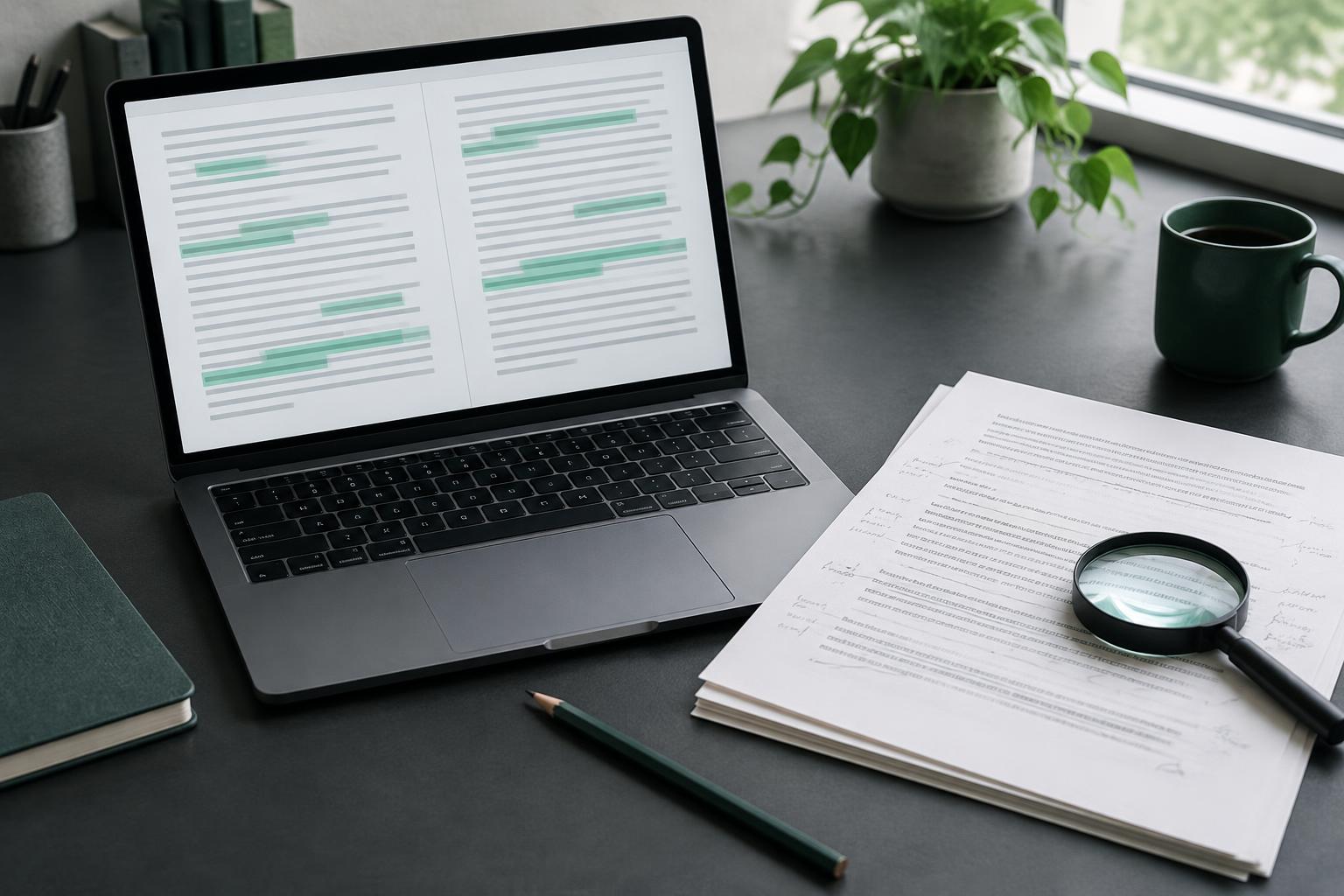
A detector score is a signal to examine—not proof of who wrote the text.
The short answer
A ChatGPT AI detector estimates whether text resembles AI-generated writing. It does not reliably establish that ChatGPT wrote a document, identify its author, or prove misconduct. “Chat GPT AI detector” is a common search phrase for third-party checking tools—not a guarantee of an official OpenAI product.
OpenAI withdrew its experimental text classifier on July 20, 2023, citing low accuracy. Its educator guidance also warns that asking ChatGPT whether it wrote an unfamiliar essay can produce responses with no factual basis. Neither a chatbot's confident answer nor a detector's percentage should become an authorship verdict. 1 2
This guide explains the technology, compares documented checking approaches, and proposes a review process for students, teachers, editors, and businesses. It focuses on a question more useful than “Can I catch ChatGPT?”: What evidence would justify the decision I am about to make?
What does “ChatGPT AI detector” actually mean?
The phrase can describe three different things: a third-party classifier marketed for detecting chatbot writing; an institution's AI-writing report; or a prompt asking ChatGPT to judge a passage. These approaches do not have the same evidential value.
A dedicated classifier analyzes the supplied text using a detection method. An institutional report embeds that analysis in a wider review workflow. A general-purpose chatbot responding to “Did you write this?” is not consulting a verified record of the document's origin. OpenAI explicitly cautions against interpreting that response as evidence. 2
The name on a tool's website is also not proof of affiliation. Check the operator, documentation, terms, and account requirements. Do not assume a service containing “GPT” in its name is made or endorsed by OpenAI.
Text detection is not a creation record
A detector normally receives the finished passage, not the actual prompts, revisions, or writing session. It infers a category from patterns. A creation record, by contrast, might include authorized draft history, source notes, or voluntarily disclosed AI interactions.
Those records can also be incomplete. A writer may work offline or use several editors. The absence of a revision trail is not proof of generation, just as a long revision trail does not automatically prove every sentence was composed without assistance.
How ChatGPT detectors work—and where inference breaks down
In broad terms, statistical classifiers learn distinctions between labeled examples of human and generated text. Implementations differ, and commercial vendors do not necessarily publish their complete methods. Predictable wording, sentence patterns, and learned representations can contribute to an estimate; none is a unique fingerprint of authorship.
GPTZero's documentation says its accuracy increases with more submitted text and that document-level classification is more accurate than paragraph-level classification, which is more accurate than sentence-level classification. It also says most of its training dataset is English prose written by adults. These are the vendor's stated characteristics, not independently verified performance figures for every user. 3
Why “perplexity” is not proof
Perplexity broadly describes how surprising a sequence is to a language model. Clear, conventional prose can be predictable because it follows an established form. That does not make it generated. Conversely, surprising phrasing does not establish human authorship.
“Burstiness” is often used informally for variation in language or sentence structure. A technical manual may deliberately maintain uniform wording; a chatbot can produce varied prose. Treat these descriptions as possible features of a method, not a universal rule that identifies ChatGPT.
Mixed assistance complicates the label
A person can research independently, ask a model to organize notes, write the draft, and use a grammar assistant at the end. Another person can paste an entire generated response. Both may involve AI, but they are not the same writing process.
A useful policy defines permitted assistance before a detector is used. Otherwise, a binary “human or AI” interface compresses several different questions into one misleading category: who supplied the ideas, who wrote the wording, whether assistance was disclosed, and whether the work satisfies the brief.
Is there an official OpenAI detector?
OpenAI's archived classifier announcement records its discontinuation in July 2023. On its historical English challenge set, OpenAI reported identifying 26% of AI-written text as “likely AI-written” while incorrectly labeling human-written text 9% of the time. These figures concern that discontinued classifier and that evaluation—not the accuracy of today's entire detector market. 1
The announcement also said the system should not be a primary decision-making tool and was very unreliable on short texts below 1,000 characters. That historical cutoff must not be silently applied to another vendor's product.
The safe conclusion is specific: do not present the withdrawn classifier as an available checking service, and do not describe ordinary ChatGPT conversations as an official authorship test. This article does not establish that every possible provenance technology is ineffective or that all future detection systems will have the same limitations.
Documented options: what the reports can and cannot tell you
The following comparison uses documentation, not a hands-on ranking. GPTZero describes limitations and holistic assessment; Turnitin explains how its AI Writing Report differs from its similarity report; OpenAI cautions against asking ChatGPT to determine authorship. 3 4 2
| Approach | What it supplies | Appropriate follow-up | What it does not establish |
|---|---|---|---|
| GPTZero classifier | A statistical classification, with available detail depending on the service | Read input limitations and discuss the writing process | The actual author, exact chatbot, or misconduct |
| Turnitin AI Writing Report | An estimate concerning qualifying prose, separate from similarity analysis | Follow institutional policy and human review | A disciplinary decision or proof of plagiarism |
| Asking ChatGPT “Did you write this?” | A generated conversational response | Do not use the answer as authorship evidence | A verified creation history |
| Authorized drafts and source notes | Context about how work developed | Assess claims, reasoning, and permitted assistance | A complete, tamper-proof record in every case |
GPTZero: review the limitation statement
GPTZero says its results should not be used to punish students and should be one part of a holistic assessment. It acknowledges errors in both directions and says highly procedural or other machine-generated text can sometimes be flagged. Heavily edited text is also described as harder to classify. 3
These caveats matter more than a prominent marketing percentage when deciding whether to use a score in a consequential setting. Confirm that your document's language, length, and genre fit the tool's documented scope.
Turnitin: AI percentage is not the similarity score
Turnitin defines its overall AI percentage in relation to qualifying prose it determines could be generated by AI or generated and subsequently modified. It explicitly separates that percentage from the similarity score and warns against using AI detection as the sole basis for adverse action against a student. 4
An institution's access to Turnitin does not make an AI result conclusive. Consult the specific report, applicable policy, and reviewer guidance rather than treating the software as the decision-maker.
Free tools: evaluate the workflow, not the price tag
A free checker may be adequate for a low-stakes demonstration using public or fictional text. Before using one on real work, examine submission limits, supported languages, explanation quality, privacy terms, and whether you can preserve the report.
This guide does not publish current free allowances or name a universal “best” detector because it did not verify every plan or benchmark the products. A paid subscription can provide more capacity without resolving the fundamental uncertainty of authorship inference.
How to read an “AI percentage” correctly
The first task is to determine what the vendor's number means. It could be a classification confidence, a proportion of eligible passages, or another scoring convention. These quantities are not interchangeable.
If a report labels 60% of qualifying prose as potentially generated, that does not mean the author used ChatGPT for exactly 60% of the whole document. It does not mean there is a 60% probability of cheating. Tables, quotations, references, and other excluded material can affect the difference between the submitted document and the assessed text.
Record four things alongside any score:
- The vendor's definition of the metric.
- The submitted text and any excluded sections.
- The tool, report date, and available version information.
- The question the review is meant to answer.
Comparing percentages across tools without checking their definitions creates false precision. Averaging several different measures does not turn them into a calibrated probability.
False positives, false negatives, and language fairness
A false positive classifies human writing as AI-generated. A false negative misses generated writing. Both can cause harm, but in different ways: the first can lead to an unjust allegation, while the second can create unwarranted reassurance.
Liang and colleagues' 2023 study evaluated several GPT detectors and documented misclassification of non-native English writing. Its findings support caution about fairness and representative testing; they do not establish the error rate of a named product's latest release in 2026. 5
GPTZero's own description of its predominantly adult English-prose training data reinforces the need to consider the actual population being assessed. A classroom with younger writers, multilingual learners, or highly formulaic assignments should not assume performance demonstrated elsewhere transfers unchanged. 3
A fictional illustration of the base-rate problem
This is invented arithmetic, not a detector benchmark. Imagine 100 documents: 10 generated and 90 human-written. Suppose a hypothetical checker flags eight generated documents and five human documents. Of the 13 flags, five would be wrong accusations if a reviewer treated every flag as proof.
The example illustrates why “most generated text is detected” is not enough information. Reviewers also need the false-positive rate, the prevalence of generated material, the sample conditions, and the decision threshold. A confident label can conceal a substantial proportion of mistaken flags.
A responsible ChatGPT checking workflow
1. Name the concern before running the tool
Separate unauthorized assistance, copied passages, fabricated references, confidentiality breaches, and low-quality writing. They need different evidence. “This sounds like ChatGPT” is an observation about style, not a complete finding.
2. Read the applicable policy
Determine whether brainstorming, translation, outlining, proofreading, or substantive drafting is allowed. Apply the policy that existed when the work was produced. Do not invent a prohibition after receiving a score.
3. Confirm permission to submit the material
A detector is an external processing service. Do not upload student records, confidential contracts, unpublished research, or customer information to an unapproved account. Check retention, training use, deletion, and third-party access for the specific service and plan.
4. Preserve the original and the report
Record exactly what was checked. An excerpt's result does not establish the origin of an entire manuscript. Avoid repeated edits and resubmissions that lose the connection between the original passage and the decision.
5. Invite an explanation without presuming guilt
Ask about sources, reasoning, drafts, and permitted assistance. Give the writer an opportunity to respond. Request only relevant records through an appropriate process; a person should not have to reveal unrelated private conversations to answer a vague accusation.
6. Verify the content independently
Open citations. Confirm quotations, calculations, product claims, and dates. Check whether the argument follows from the evidence. A document that scores “human” can still be fabricated, plagiarized, or useless.
7. Record a proportionate conclusion
A defensible review can conclude that authorship remains unresolved while identifying a clear factual defect. Explain the evidence, uncertainty, policy, and next step. Where academic or employment consequences are possible, follow the institution's formal review and appeal procedures.
What to do if your own writing is flagged
Keep the submitted version and ask which tool, passage, metric, and policy prompted the concern. Provide relevant notes, sources, or drafts if available, and explain any allowed assistance accurately.
Do not fabricate a revision history or falsely deny AI use. Equally, do not assume a detector flag establishes wrongdoing. Ask for contextual human review and an opportunity to explain the work. Missing records should be evaluated fairly rather than treated as automatic confirmation.
For future projects, agree on assistance and disclosure rules at the start. Maintain reasonable source notes and draft records as part of normal work—not as a promise that every sentence can be forensically reconstructed.
For editors and marketers: authorship is not the quality gate
An editorial team should evaluate accuracy, sourcing, originality, usefulness, and disclosure. Detection can raise a question, but it cannot replace those checks or certify that an article contains genuine expertise.
Google says generative AI can help with research and structuring original content, while generating many pages without adding value may violate its scaled-content-abuse policy. Its guidance emphasizes accuracy, quality, relevance, and manual fact-checking and review. It does not set a commercial detector score as an SEO requirement. 6
Do not invent first-hand experience, customer outcomes, quotations, or product tests to make writing appear “more human.” The better target is verifiable knowledge. A byline should identify real editorial responsibility; a disclosure should describe assistance truthfully.
A fictional editorial scenario
The following is invented, not a client result or product test. Harbor Ledger, a fictional accounting publisher, receives a guide that a checker flags. The editor does not immediately reject it. Instead, the editor verifies cited tax guidance, asks how the draft was prepared, and checks whether the article explains a useful decision.
The writer discloses permitted outlining assistance and supplies research notes. Two unsupported claims are removed. The publication records what was verified and the assistance used, without awarding a “100% human” badge. The outcome is a stronger article—not an attempt to engineer a lower score.
How to evaluate a detector without inventing an accuracy ranking
Before adopting a tool, define the real use case and assemble authorized samples with documented origins. Include the languages, genres, lengths, and assistance patterns your process will encounter. Keep mixed-assistance categories explicit rather than forcing everything into an unexplained binary label.
Measure false positives and false negatives separately, retain the sample sizes and threshold, and document the date and available version. Inspect errors by relevant subgroup without drawing sweeping conclusions from tiny samples. Ensure the people reviewing results know what the metric means.
This is a proposed evaluation framework, not research LinkinGrow has performed. No accuracy percentage, product winner, or operational threshold is recommended here. If the observed errors are unacceptable for the proposed decision, do not deploy the tool for that decision simply because the interface is convenient.
Common questions
Can an AI detector prove ChatGPT wrote my essay?
No. A statistical classification is not a verified record of authorship or model identity. Review the writing process and applicable policy rather than treating a flag as proof.
Can ChatGPT identify whether it wrote a passage?
OpenAI warns that ChatGPT responses to this question can be made up and have no factual basis. Do not use them as authorship evidence.
Is GPTZero the same as ChatGPT?
No. GPTZero is a separate detection service. A name containing “GPT” does not establish an OpenAI affiliation or access to your private ChatGPT history.
Does an AI-writing report prove plagiarism?
No. Similarity to existing material and inference about generated writing are different questions. Turnitin explicitly separates its AI percentage from its similarity score.
Can human-written text trigger a detector?
Yes. Vendor documentation acknowledges false classifications, and dated research raises fairness concerns. A flag requires context rather than an automatic allegation.
Is a zero AI score a guarantee?
No. A negative result does not prove human authorship, truthful claims, original work, or compliance with a policy.
Should I rewrite text until it passes every checker?
No. Improve clarity, evidence, and attribution, and disclose assistance as required. Optimizing for detector scores is not a substitute for responsible writing.
Will Google penalize a page because a checker says AI?
This guide identifies no documented rule tying a commercial detector score to a Google penalty. Google's published guidance focuses on value, accuracy, and spam-policy compliance.
Sources, method, and disclosure
This is AI-assisted, source-checked editorial analysis, not a hands-on detector review, an independent benchmark, or legal or disciplinary advice. The comparison is based on documentation checked on November 23, 2026. No affiliate placements, fabricated tests, or real student records were used. Both worked examples are fictional.
OpenAI's educator guidance, GPTZero's limitations, Google's guidance, and the research abstract were retrieved directly. OpenAI's archived classifier announcement and Turnitin's report guidance were checked through retrieved search text. Historical findings are labeled by date and are not presented as measurements of current products. The reused AI-generated illustration does not depict a real detector report.
- OpenAI: Archived classifier announcement and discontinuation notice
- OpenAI: Educator guidance and the limits of detector judgments
- GPTZero: Limitations of its AI classifier
- Turnitin: Using the AI Writing Report
- Liang et al.: GPT detectors are biased against non-native English writers, 2023
- Google: Guidance on using generative AI content on your website